
Matfyz Authors of a Digital Physics Textbook on Czech Television
On 8 September 2026, Vojtěch Žák and Věra Koudelková from the Faculty of Mathematics and Physics (Matfyz) presented a new digital physics textbook for secondary schools on Czech Television's Studio 6. They brought magnets and a disassembled kitchen appliance into the studio to show how everyday objects can help students appreciate physics.
The first volume of the series is titled Základy středoškolské fyziky: Elektřina a magnetismus (Fundamentals of Secondary School Physics: Electricity and Magnetism). Its authors are Vojtěch Žák, head of the Department of Physics Education at the Faculty of Mathematics and Physics, Charles University, together with Věra Koudelková and Petr Kolář. The textbook was published by MatfyzPress, the faculty's publishing house, and its digital version is available on the FutureBooks platform.
What a fridge magnet can reveal
Věra Koudelková showed that even an "ordinary" fridge magnet can be surprising. A magnetic viewing film reveals a row of alternating north and south poles on it. The magnetic seal on a refrigerator door has the same kind of arrangement.
The demonstration reflects the approach of the whole textbook: start with something familiar, ask a question and look for the answer through an experiment. As Věra Koudelková said in the interview, "you can do interesting experiments with everyday things."
Vojtěch Žák then introduced a chapter that the authors call, as a working title, "dissecting household appliances." Taking appliances apart shows how the laws of physics work inside devices we use every day. The chapter aims to explain how these devices work and is not meant as a repair guide. In the textbook, students will find photographs of the appliances along with questions and explanations.
Why the authors chose a digital format
A digital environment makes it possible to combine text with photos, videos and other interactive elements. Students can first try an experiment themselves and then compare their results with the authors' results and measurements. They can open the textbook on a tablet, a laptop or even a mobile phone.
Another advantage is that the textbook can be updated continuously. The authors can correct any inaccuracies, add new content and check that web links still lead where they should.
Schools helped test the textbook
Before this volume was published, it was piloted in classrooms, along with related research at schools. The results also shaped the final textbook. According to Vojtěch Žák, the original plan for interactivity was too extensive, so the authors cut back some of the multi-level "click-to-expand" sections.
Suggestions for changes can also come in after publication. The textbook includes a QR code for sending feedback, whether it is about a typo or, for example, a missing topic.
For students and their teachers
The textbook is intended not only for grammar schools but also for other secondary schools, including technical schools, and is typically used for a two-year physics course. The teacher's version adds teaching notes, including a list of the equipment needed for the experiments.
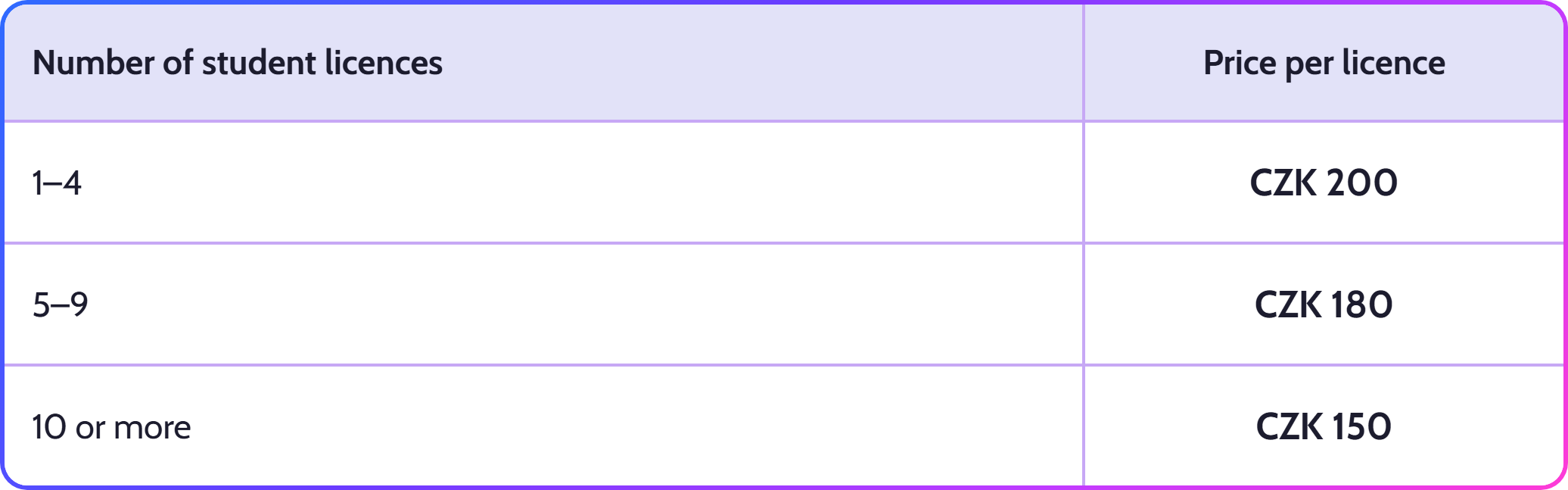
Schools can buy several licences together for a whole class. A bundle of 15 student licences plus one free teacher's version costs CZK 2,250. For student licences bought individually, the price depends on how many are bought:
More volumes are on the way
Alongside the completed Elektřina a magnetismus, the volumes Mechanika (Mechanics), Termika (Thermal Physics), Optika (Optics) and Mikrosvět (The Microworld) are being prepared. They are being written by colleagues from the same department, and each volume will also have a teacher's version.
In the September interview, the authors said they plan to publish Mechanika this winter. Under the plan they presented, the remaining volumes should follow at intervals of no more than six months.
Try a sample chapter for free
You can see the authors' approach to physics education for yourself in the textbook. The MFF FutureBooks e-shop offers a free sample chapter, with no registration and no payment details needed. Go through the questions, look at the experiments and see how the textbook could help in your teaching.
The interview is also available in the Czech Television archive. You can find it in the full episode of Studio 6, from 00:50:13 to 00:59:30.